I am working and banking up a handful of posts upcoming, but I want to give you a little something to chew on for the week. (In the literary world, that is called a "pun." I hope you liked it.)
A while back I talked about breakfasts being the most important meal of the day. I want to revisit that topic, as I've been in the habit of eating more breakfasts and eating better in general. Almost every morning I get up and work out and then eat at the office. And I eat all morning. Spaced over the course of four hours I eat 3/4 cup green lentils with cinnamon and sugar (recipe, below), an apple, a banana, four ounces of non-fat Greek yogurt and one or two hard boiled eggs. Maybe some almonds and dried blueberries.
So what's the key to eating this much and this nutritiously everyday? Planning and flavor. Let's be honest, I'm not very motivated toward being responsible. I'm a kid at heart. I hate wearing a seatbelt (sorry Mom), I don't floss often enough (sorry Dr. Sadar) and I wouldn't eat my breakfast unless it's tasty and I don't have to work hard at that hour to make it.
So, I keep it simple. Sunday night, I put one and a half cups of dried lentils in a large bowl and add 2 cups water to soak over night. Monday morning, when I wake up and start working out, I rinse the lentils and put them in the pot to boil. I let them simmer and by the time I'm done with one work out, I have a week's worth of breakfast lentils. Yipee! (Ok, that's an over-reaction. They are just lentils.)
This is simple, but meaning stuff. Little changes make big changes possible. Who knows? Maybe I'll even start wearing my seatbelt.
Green Lentil Breakfast
1 1/2 cups Dried Green Lentils (Pick through them. You never know what debris you'll find. I've found other seed pods, stalks, even small rocks.)
2 1/2 cups Water
2 3/4 cups Water
1 1/2 teaspoon Salt
Cinnamon
Sugar
In a large bowl, soak the lentils in 2 1/2 cups of water for at least 8 hours.
Rinse the lentils in a sieve and put them into a large pot, and sprinkle with salt and add the remaining water. (For an extra treat, add 6-8 green cardamom pods.) Bring to a boil, then simmer for 20-25 minutes. The lentils should be tender, but not mush.
Sprinkle with a mix, 1:6 ratio, of cinnamon to sugar. Stir in and eat hot or cold. (I like to let the lentils cool and then store in individual serving containers.)
And just because you've been good:
How to Hard Boil an Egg
Most people abuse the hard boiled egg because they believe they can't screw it up. You can screw anything up. You know that rubbery egg white and a yolk that has a green lining around it? It's over cooked. This will help.
1 Egg
3 cups Water (at least)
In a sauce pan, add at least three cups water. You want a lot of water so the temperature of the water doesn't drop when the egg(s) are added.
Bring the water to a boil. Add the egg. Return the water to a boil as fast as possible (i.e. put the lid on the pot), reduce your heat to a low rolling boil and cook for 11-12 minutes. (This is at my altitude. I'm a mile above sea level. You will only need about 9-10 minutes at sea level.)
Immediately drain the eggs and soak them in ice water. You want to stop them cooking as quickly as possible. Level them soak in ice water for 15-20 minutes.
Eat them however you wish. I like hot sauce on mine.
Showing posts with label vegetarian. Show all posts
Showing posts with label vegetarian. Show all posts
Tuesday, September 3, 2013


Sunday, August 11, 2013
A letter from Spain
Hello friends and relatives.
We have traveled to the foreign soils of the Iberian Peninsula, to the town of Barcelona, and in our initial foray, have beheld numerous sights leading to these shared observations.
First, the people of Europe look categorically malnourished by American standards, although there is hope. Whereas I've noticed the healthy girth of American waistlines and shorts that ride up as one walks down an American street, the same features are far less prevalent in our friends across The Pond. Many women, for example, have thighs which barely touch as they walk! Blessedly, now and then, we can see the native German or Italian or sometimes even Spaniard with a shirt or pant-size of which to be truly proud, and this gives my heart encouragement. Still, the Dutch and Swedes are far too tall, winsome and thin to be fully equipped for general healthy living let alone their long winters.
 Which leads me to my Second Important Point: I believe the food to be the cause of the generally lean nature of these inhabitants. The cuisine here focuses on delicious cured meats, recently caught seafood, fine cheeses and fresh fruit and vegetables. Even the toast is spread with wholesome olive oil and a thin tomato juice--the natives literally rub a fresh, sliced, juicy tomato over the bread toasted in olive oil. Granted, there is wine plenty enough to spare, but with the wholesomeness of the cooking, one must consume vast quantities of both to maintain one's fortitude. Blessedly, the Catalonians are generous by their very nature.
Many in Spain walk the streets looking for such sustenance. The shops and restaurants are open late (10:00 pm to 12:00 am is standard for dining) and the sidewalks are wide to accommodate their numbers. Roads lace and interweave with these walkways and are filled with speeding taxi cabs and vehicles of the sporting wealthy class. You see, it appears to be a great entertainment for the walkers--possibly as a brief diversion from there plighted march to the next feeding station--to dodge among the vehicles zipping past. In their turn, the cars and motorbikes seem to speed up if their headlights catch the sight of human prey in their sweep. Although the odds seem to favor the automobile by the sheer numbers of pedestrians in the street, still we have not seen the fallen footman taken by their determined nemesis. This dodging and darting seems to be frivolous sport, burning precious calories.
There exists, along this treacherous migration, some respite. When the enthusiasm for the sport has waned, we've witnessed small packs of participants reclining on any of the numerous benches provided by the city founders. If benches are too distant, these same weary sojourners will squat in nearly any doorway, alley or parking garage. The poor, confused waifs, in an attempt to satiate their ever-present hunger (owing to their being so thin), have taken to putting all nature of things in their mouths, most commonly, lit cigarettes. Sadly, cigarettes depress appetite but do nothing for adding needed pounds.
Perhaps the cigarettes are aging their population. Observe: throughout your day, in Europe or even back home, you will witness the grizzled and weathered faces of elderly men or women holding cigarettes between their knotted fingers. However, you will never see the same haggard, wrinkled visage on the obese. I firmly believe that our extreme calorie count preserves our youth--right up to the day we die.
We depart this fascinating city, half a world away from you all, in the morning. I will send more news as events warrant.
Humbly yours,
--M
If you feel the need to try something tasty and not very fattening, try:
Catalan Tomato Toasts
2-3 slices of Bread per person
Olive Oil
1-2 ripe Tomatoes per person (the big round ones, not Roma or Plum tomatoes--those are too dry)
pinch of coarse Salt and cracked Pepper, if desired
Heat 2 tablespoons of olive oil in a flat bottomed skillet on medium to medium high heat. Lay the bread in to fry, 2-3 minutes or until they're cooked the way you like them. Turn over and toast the other side in the remaining oil (if there is any) for 1-2 minutes. Remove the toast to a warm plate. Repeat with the rest of the bread.
Cut the tomatoes in half. While the toast is hot, rub the cut side of the tomato into the toast, letting the bread absorb the juice and seeds and pulp. Use a half of a tomato for every 1-2 pieces of toast.
Sprinkle with a little salt and pepper if you like that sort of thing. I do.
Serve by itself or on a platter with meats, cheeses and dried fruits.
Satire noun (\ˈsa-ˌtī(-ə)r\)
1: a literary work holding up human vices and follies to ridicule or scorn
2: trenchant wit, irony, or sarcasm used to expose and discredit vice or folly
Sunday, July 1, 2012
Can We Have a Grown-up Talk?
I love indulging my passions. A fly
on the wall would be both shocked and amused at my antics. Spend more than a
few hours with me and I bet you would be too. While I can maintain a
professional attitude at work and I prefer not to swear in front of my mom,
most social conventions get thrown out the window when I'm left to my own
devices for too long. I similarly prefer to surround myself with people a lot
like me, which also means that we become enablers, or even instigators, to each
other. I have been witness to or participated in most of the wonderful vices
known to modern man.
Which takes me to porn. Don't turn away! I'm not going to embarrass you, me or my mom in this conversation. (While I'd love to say that I'll actually make my mom proud with this post, that wouldn't exactly be accurate either. Probably.)
Pornography has been around for a long time. Frescos uncovered in the ancient city of Pompeii (buried under 20 feet of volcanic ash in AD 79) depicted graphic scenes of handsome men and beautiful women doing their best to illustrate the entire catalogue of The Birds and the Bees. Man/Woman, Men/Women, Man/Man, Woman/Woman and sometimes Man/Woman/Member of the Animal Kingdom. Pretty much everything there to view. Like a very educational Google search. Or late night Cinemax.
Do you know what Bree Olson isn't? She isn't real. Bree Olson isn't her real name. You can find her stats and dimensions; her turn ons and turn offs; what she thinks about the industry, Charlie Sheen, and religion. But you and I don't know what she's like in an arguement. We don't know how she cleans her house, how she cuddles up to a loved one when she's tired, nor the quirks she has about shopping. In short, we don't have a person. We have a porn starlet.
Pornography is a poor (albeit sexy) imitation of a relationship. It doesn't show the day-to-day events and activities that build a partnership. It doesn't show taking out the trash, changing the diapers or rubbing your beloved's feet. It only shows you . . . well . . . you know.
And THAT is why I hate the term "food porn." Example: While I love Neil Patrick Harris, and he has a great Twitter feed of beautiful food from famous restaurants from all over the world, (@NPHFoodPorn), the real beauty of the food he is enjoying is NOT in the picture of the dish, but in the making and sensuality of it.
Food porn doesn't show you the ingredients, challenges, efforts and triumphs of truly wonderful cuisine. The time it takes assemble disparate parts; the sweat in a hot kitchen; the sticky fingers; flour hanging in the air; the smell of soup-stock simmering on the stove. This where my relationship to food gets permanently fixed in my soul.
But here's the rub: I still love looking at pictures of food. The experience can be inspirational. There is a fantasy, a desire, a carnal wanting that makes you crave more. Yes, even though I hate the thought of food porn, I indulge in it, too. The preacher also sins.
So here's a couple of recipes that could be food porn, but I am better for having had the relationship.
 Thank you to my friend at Indian
Food Rocks for inspiring me and pointing me in the right direction. This
particular recipe was adapted from recipes found extensively on the internet.
In a wide-mouth mason jar, layer rose petals and sugar. Somewhere in the middle, sprinkle in the spices. Finish with rose petals on top.
Seal the jar and place it in the sun for 6 hours a day for 3-4 weeks. Every other day, open the jar and give it a stir with the handle of a wooden spoon. (Opening the jar also allows you to indulge your senses by taking a whiff. I have to imagine this is what faerie farts smell like.) There will be condensation in the jars. This is good.
After 3-4 weeks, the petals break down and everything turns dark and muddy in color. This is also good. The sugar crystals melt and clump and pick up color and flavor. You can eat the gulkand right off a
spoon (Lord knows I do!) or you can add it to other ingredients. It combines
well with alcohol. Mix a tablespoon of gulkand in 2 oz of water, 2 oz of good
gin and 1 oz of vodka. Stir until the sugar has dissolved. Add the fresh juice
of 1/2 lemon, shake over ice for 30 seconds and strain into a cocktail glass.
refreshing on a summer night!
Which takes me to porn. Don't turn away! I'm not going to embarrass you, me or my mom in this conversation. (While I'd love to say that I'll actually make my mom proud with this post, that wouldn't exactly be accurate either. Probably.)
Pornography has been around for a long time. Frescos uncovered in the ancient city of Pompeii (buried under 20 feet of volcanic ash in AD 79) depicted graphic scenes of handsome men and beautiful women doing their best to illustrate the entire catalogue of The Birds and the Bees. Man/Woman, Men/Women, Man/Man, Woman/Woman and sometimes Man/Woman/Member of the Animal Kingdom. Pretty much everything there to view. Like a very educational Google search. Or late night Cinemax.
Like ancient Rome, porn is now going
much more mainstream than it used to be, even a few decades ago. Do you know
who Bree Olson is? If your first guess was Porn Star, then you are a guy and I
know what you've been doing with your computer. If you answered, "Porn
Star who famously hooked up with Charlie Sheen and that other woman during
Charlie's near downfall, and then got even more famous by telling her part of
the story to TMZ," you would also be right and have illustrated my point.
Do you know what Bree Olson isn't? She isn't real. Bree Olson isn't her real name. You can find her stats and dimensions; her turn ons and turn offs; what she thinks about the industry, Charlie Sheen, and religion. But you and I don't know what she's like in an arguement. We don't know how she cleans her house, how she cuddles up to a loved one when she's tired, nor the quirks she has about shopping. In short, we don't have a person. We have a porn starlet.
Pornography is a poor (albeit sexy) imitation of a relationship. It doesn't show the day-to-day events and activities that build a partnership. It doesn't show taking out the trash, changing the diapers or rubbing your beloved's feet. It only shows you . . . well . . . you know.
And THAT is why I hate the term "food porn." Example: While I love Neil Patrick Harris, and he has a great Twitter feed of beautiful food from famous restaurants from all over the world, (@NPHFoodPorn), the real beauty of the food he is enjoying is NOT in the picture of the dish, but in the making and sensuality of it.
Food porn doesn't show you the ingredients, challenges, efforts and triumphs of truly wonderful cuisine. The time it takes assemble disparate parts; the sweat in a hot kitchen; the sticky fingers; flour hanging in the air; the smell of soup-stock simmering on the stove. This where my relationship to food gets permanently fixed in my soul.
But here's the rub: I still love looking at pictures of food. The experience can be inspirational. There is a fantasy, a desire, a carnal wanting that makes you crave more. Yes, even though I hate the thought of food porn, I indulge in it, too. The preacher also sins.
So here's a couple of recipes that could be food porn, but I am better for having had the relationship.
Gulkand
 Thank you to my friend at Indian
Food Rocks for inspiring me and pointing me in the right direction. This
particular recipe was adapted from recipes found extensively on the internet.
4-5 cups of aromatic Rose Petals
(see recipe, below, to keep it safe)
2 cups White or Raw Sugar (I like
more sugar than is usually suggested)
3 Cardamom Pods
2 teaspoons Coriander Seeds
4 Whole Cloves
Early in the morning, while your
roses are just opening up for the day, snip the best-looking rose heads into a
bowl. Make sure the roses are free of bruises, blemishes and BUGS! This is not
part of my entymophagy post. Separate the petals from the rest of the rose
head, and lay the petals out on a paper towel. Don't bother patting them dry
but do remove any excess water. Discard any petals that are badly damaged,
bruised, dried and crinkly, etc.
In a wide-mouth mason jar, layer rose petals and sugar. Somewhere in the middle, sprinkle in the spices. Finish with rose petals on top.

Seal the jar and place it in the sun for 6 hours a day for 3-4 weeks. Every other day, open the jar and give it a stir with the handle of a wooden spoon. (Opening the jar also allows you to indulge your senses by taking a whiff. I have to imagine this is what faerie farts smell like.) There will be condensation in the jars. This is good.
After 3-4 weeks, the petals break down and everything turns dark and muddy in color. This is also good. The sugar crystals melt and clump and pick up color and flavor.

Orange Lavender Bitters
Like the bitters before, but MUCH
better.
750ml Everclear
3 tablespoons Coriander Seeds
1 Anise Star
1 teaspoon Allspice Berries
2 teaspoons Peppercorns (I used
white. That's what I had on hand.)
1 California Bay Leaf
8oz Dried Orange Peel
25 Drops Gentian Root Extract
8oz Dried Lavender Flowers
In a clean jar, combine all the dried ingredients EXCEPT for the lavender. Add the Everclear and the gentian root extract. Seal the jar and store in a cool, dark place for 7 days. Give it a good shake once a day. The liquid should start to turn orange.
After the first week has passed, add the lavender. Shake once a day for 7 more days.
Strain it through a seive to catch the big stuff, then double filter it through a pitcher water filter (I use a Brita).
When it is pretty clear (although very dark), put it in a sauce pan over medium low heat. Reduce it to 1/2. Store in clean jars.

In a clean jar, combine all the dried ingredients EXCEPT for the lavender. Add the Everclear and the gentian root extract. Seal the jar and store in a cool, dark place for 7 days. Give it a good shake once a day. The liquid should start to turn orange.
After the first week has passed, add the lavender. Shake once a day for 7 more days.
Strain it through a seive to catch the big stuff, then double filter it through a pitcher water filter (I use a Brita).
When it is pretty clear (although very dark), put it in a sauce pan over medium low heat. Reduce it to 1/2. Store in clean jars.

Sunday, April 15, 2012
Dessert on a Diet
The Quest: Make a dessert high in nutritional value, that tastes great and is relatively low in calories. Bonus: Vegan (I want EVERYONE to be able to enjoy this.)
Double Bonus: The cooking time is less than a half hour, although the refrigeration is 4 hours.
The Experiment: A different kind of Panna Cotta.
Back Story: Everyone will recognize that I've had no professional training for cooking. Almost everything I've learned I picked up from my parents, reading cook books, watching TV and videos and lots of trial and error. You also know that I've been on a bit of a health kick of late. I want to look and feel better all of the time. But I'm still a glutton at heart. I love sweet, salty, rich and creamy foods. How can a glutton have everything he wants?
The Players: Panna cotta is a milk-based dessert set using animal-based gelatin. Neither of these things are allowed in a vegan diet. What can be substituted for whole milk? Nothing really, but I tried both unsweetened soy milk and plain almond milk. I liked the taste of almond better. It also has less fat (good for me, bad for dessert), less calories and more nutrition than soy. Even more challenging, I need to find a substitute for heavy cream. I selected canned, unsweetened coconut milk. It has a relatively high fat content (although nowhere near real cream), is naturally sweet and rich. To set the gel, I looked for plant substitutes. Agar (or agar agar) is a structural agent found in the cell walls of red algae. I found it in the baking aisle of my local grocery store, in thread and powdered form. (Like the adventuresome idiot I sometimes am, I got my agar agar from the Pacific Ocean Marketplace years ago before I knew what it was or how to use it. It's been sitting in our pantry for at least 5 years.)
If I stopped here, the panna cotta would taste ok, but not great. The really rich creaminess just can't be brought to life without richer and creamier ingredients. Therefore, I decided to go in a different direction. I added a can of pumpkin puree and 2 tablespoons of grated fresh ginger to really punch up the "wow" factor. The resulting mix has only 94 calories, 110% daily requirement of vitamin A, 10% daily requirement of vitamin C, is high in dietary fiber, calcium and iron, has 0 cholesterol, and only 4 grams of fat. And it tastes GREAT!
The resulting panna cotta? A failure the first time around. It didn't gel. That was a fear of mine with so little fat.
The next try? Stay tuned.
Tonight for dessert, we're having:
Vegan Pumpkin GingerPanna Cotta Ice Cream
1 cup Almond Milk
2 tablespoons Agar Agar Threads
1 can (15oz) Pumpkin Puree
2 tablespoon grated fresh Ginger
2 cups Coconut Milk
1 teaspoon Vanilla Extract
6 tablespoons Sugar
pinch of Salt
Pour the almond milk into a medium sauce pan and sprinkle the agar evenly over the surface of the milk. Let stand for 10 minutes to allow the agar to hydrate. Get the rest of your ingredients ready and also fill a very large mixing bowl 1/2 way with ice and add enough water to let the ice cubes float off the bottom. Get another bowl ready that is small enough to fit inside the large bowl, and large enough to hold about 6-8 cups of liquid. Also set out the ramekins or cups you will use for chilling.
Heat the almond milk and agar on medium heat, stirring constantly, until the agar dissolves completely and the temperature reaches 135 degrees on an instant read thermometer. Remove from the heat and stir in the sugar and salt until dissolved.
Pour the almond milk mixture, the coconut milk, pumpkin, ginger and the vanilla into the smaller of the two bowls and place that bowl into the ice water bath. Stirring constantly, chill the mixture to 50 degrees.
Pour the finished mixture into the cups, cover with plastic wrap and refrigerate for 4 hours.
To serve, dip the cup into hot water for 15-20 seconds, making sure not to let any water spill into the panna cotta. Wet your finger and gently run it around the edge of the cup loosening the panna cotta's hold. Turn out onto a serving plate and top with your favorite syrup, sauce, fruit, nuts, etc.
Pour all the ingredients into the ice cream mixer. Add 6 more tablespoons sugar and 1 teaspoon of ground cinnamon. Mix and chill according to the mixer's instructions. Freeze for a bit longer. Serve 2 scoops in a bowl or on a cone. Contemplate another solution to the panna cotta dilema.
Double Bonus: The cooking time is less than a half hour, although the refrigeration is 4 hours.
The Experiment: A different kind of Panna Cotta.
Back Story: Everyone will recognize that I've had no professional training for cooking. Almost everything I've learned I picked up from my parents, reading cook books, watching TV and videos and lots of trial and error. You also know that I've been on a bit of a health kick of late. I want to look and feel better all of the time. But I'm still a glutton at heart. I love sweet, salty, rich and creamy foods. How can a glutton have everything he wants?
 |
| This is my problem. I can't read this. Neither can you. So, don't judge me. |
 |
| The cast of characters. |
The resulting panna cotta? A failure the first time around. It didn't gel. That was a fear of mine with so little fat.
The next try? Stay tuned.
Tonight for dessert, we're having:
Vegan Pumpkin Ginger
1 cup Almond Milk
2 tablespoons Agar Agar Threads
1 can (15oz) Pumpkin Puree
2 tablespoon grated fresh Ginger
2 cups Coconut Milk
1 teaspoon Vanilla Extract
6 tablespoons Sugar
pinch of Salt
Pour the almond milk into a medium sauce pan and sprinkle the agar evenly over the surface of the milk. Let stand for 10 minutes to allow the agar to hydrate. Get the rest of your ingredients ready and also fill a very large mixing bowl 1/2 way with ice and add enough water to let the ice cubes float off the bottom. Get another bowl ready that is small enough to fit inside the large bowl, and large enough to hold about 6-8 cups of liquid. Also set out the ramekins or cups you will use for chilling.
Heat the almond milk and agar on medium heat, stirring constantly, until the agar dissolves completely and the temperature reaches 135 degrees on an instant read thermometer. Remove from the heat and stir in the sugar and salt until dissolved.
Pour the almond milk mixture, the coconut milk, pumpkin, ginger and the vanilla into the smaller of the two bowls and place that bowl into the ice water bath. Stirring constantly, chill the mixture to 50 degrees.
Pour the finished mixture into the cups, cover with plastic wrap and refrigerate for 4 hours.
Pour all the ingredients into the ice cream mixer. Add 6 more tablespoons sugar and 1 teaspoon of ground cinnamon. Mix and chill according to the mixer's instructions. Freeze for a bit longer. Serve 2 scoops in a bowl or on a cone. Contemplate another solution to the panna cotta dilema.
Sunday, February 26, 2012
Planning to Lose
The Diet continues. As mentioned in my Facebook page, I'm down 17 pounds from the beginning of the year (with a few side effects--the benefits of a more vegetable-based diet). That's the easy weight, however. The real challenge begins now.
This is good. I'm establishing the habits of awareness and am far more cogniscent of what I put into my body. I've always taken pride in cooking from scratch and using whole foods as much as possible, but now I also look at quantity and diversity of what I eat. Whereas, in my previous diet, I would eat all of the whole grains (quality carbs) and proteins (primarily lean meats) I wanted, now I eat a tremendous quantity of leafy greens. Kale is my new BFF. Lentils, other legumes and beans provide complex carbs, proteins and iron.
My plate and my biological functions have become more colorful.
Now I'm adding exercise. Like budgeting for money or calories, budgeting time is also a challenge. The question of how to spend a limited resource forces one to cut back in some areas to make room for something new. Unlike money or calories, however, additional time cannot be created. (You can take on another job or work extra hours for more money. Exercising burns calories that are then available for extra gluttony.) The time budget is therefore essential.
One thought: multitasking. I am essentially a lazy person who loves his leisure time. I'm not a huge TV watcher, but I love movies. I can easily combine many calesthetics and simple weight training with movie watching time. I am walking my dog a little more than 3 miles during lunch. (Added bonus: I eat less during lunch and have smaller healthy snacks throughout the day.)
Overall, however, I think I will have to make some time for concentrated, focused exercise. 30 minutes a day? 45 minutes? I'm not sure yet. I'll keep you posted.
For snacks, try these nutritional delights:
Baked Kale Chips
This is an adaptation of a recipe suggested to me by a very good friend. Thank you SO MUCH. I love this.
zest and juice of one Lime
Salt (I prefer Table Salt, here)
2 tablespoons Olive Oil
1 bunch of Kale
Preheat oven to 350 degrees. Line a cookie with parchment paper.
Seperate the leaves from the coarse and fiberous, stem-like midrib. Tear the leaves into bite-sized pieces. Wash and use a salad spinner to dry. Toss with olive oil (a little goes a long way--2 tablespoons works well), zest and sqeeze of 1/2 of a lime (a whole lime maybe needed if it's not very juicy).
Lay the leaves out flat on the cookie sheet. Be sure they don't overlap much. Sprinkle lightly with salt.
Bake for 10-13 minutes, or until dried and crispy.
These will keep in a well sealed container in a cool location for up to a week. You'll eat them in an afteroon.
Granola Bars
These are delicious, easy and cheap. You can vary the ingredients to your heart's desire.
3 cups Rolled Oats
1/2 cup Sliced Almonds
1/2 cup Raisins
1/2 cup Dried Apples, diced
1/2 cup Dried Banana Chips, crumbled
1/2 cup Sunflower Seeds
1/2 cup Wheat Germ
1 cup Honey
1/2 cup Brown Sugar
1 teaspoon Salt
3 tablespoons Unsalted Butter, Margarine or Vegetable Oil (or a combination)
2 teaspoons Vanilla Extract
Preheat the oven to 350 degrees.
Spread the oats, almonds, sunflower seeds and wheat germ evenly on a cookie sheet. Bake for 15-20 minutes until arromatic and toasted. (Stir occassionally to keep from burning.)
While the dry ingredients are toasting, heat the butter, salt, honey and brown sugar on medium high heat until it starts to bubble. Then reduce the heat to a simmer. Again, stir. This time constantly until the brown sugar is completely melted. Remove from the heat and stir in the vanilla.
Spray a 9x13 baking pan with cooking spray. Reduce the oven temperature to 300 degrees.
In a large bowl, combine wet ingredients into the dry ingredients. Stir until well combined. Pour the mix out into the baking pan. Using the back of wooden spoon or a heavy flat spatula, press the mixture as flat in the pan as possible. It needs to be densly packed to hold together.
 Bake for 25 minutes. Remove from the oven and let cool for 15 minutes. Cut into sections (I got 15 pieces). Let cool some more, then remove from the pan, separate the pieces from each other and place on waxed paper. After an hour or so, wrap in waxed paper for individual treats and place in a cool dry place for up to a week.
They make a great breakfast treat or quick snack.
Fruit and Nut Pizza
 I tend to have pizza dough on hand. It keeps in the refridgerator for a while, but it tends to ferment--like sourdough. Use what you need and keep the rest for later. Just let it come (mostly) to room temperature before using it.
Pizza Dough
4 1/4 cups Bread Flour, plus extra for kneading
1 teaspoon Salt
2 packages Yeast
2 tablespoons Brown Sugar
1 1/2 cups Warm Water (think bath temperature)
1/4 cup Olive Oil
Filling
1 tablespoon Raisins
1 tablespoon Sunflower Seeds
2 teaspoons Wheat Germ
1 teaspoon Kasha (roasted and cracked buckwheat)
Toppings
Honey
Cinnamon and Sugar
sliced Apple (Granny Smith)
sliced Banana
sliced Almonds
To make the dough: stir the yeast and brown sugar into the water until disolved. Let it foam up (about 10 minutes). Combine the flour and salt in a stand mixer with a dough hook. Start on the lowest speed and pour in the wet ingredients. Mix until it comes together in a ball. Turn out onto a floured counter and knead. Place in a warm, still location and let rise for an hour (or until doubled in volume). Punch down.
(If you've been refridgerating the dough, let the dough warm up and start from here.)
Preheat the oven to 400 degrees.
Tear off a hunk of dough about the size of the palm of your hand. That's good for 1 person. Flour the counter top and spread the dough out from the center until it's rather flat. Sprinkle the fillings into the center and knead. The fillings will fall out and push through. It's ok. Keep kneading and incorporating what falls out. Using a rolling pin, roll the dough out turning and flipping to try and keep a round shape. Transfer to a dusted silicone cutting mat. Dock the dough (poking it all over with a fork) to keep it from poofing up too much.
Sprinkle liberally with cinnamon and sugar. Arange the apple, banana and almonds. Drizzle with a little honey and sprinkle with a little more cinnamon and sugar.
I use a pizza stone, but if don't have one, use a cookie sheet. Transfer the pizza to either the stone or the cookie sheet and bake for 12-15 minutes.
This is good. I'm establishing the habits of awareness and am far more cogniscent of what I put into my body. I've always taken pride in cooking from scratch and using whole foods as much as possible, but now I also look at quantity and diversity of what I eat. Whereas, in my previous diet, I would eat all of the whole grains (quality carbs) and proteins (primarily lean meats) I wanted, now I eat a tremendous quantity of leafy greens. Kale is my new BFF. Lentils, other legumes and beans provide complex carbs, proteins and iron.
My plate and my biological functions have become more colorful.
Now I'm adding exercise. Like budgeting for money or calories, budgeting time is also a challenge. The question of how to spend a limited resource forces one to cut back in some areas to make room for something new. Unlike money or calories, however, additional time cannot be created. (You can take on another job or work extra hours for more money. Exercising burns calories that are then available for extra gluttony.) The time budget is therefore essential.
One thought: multitasking. I am essentially a lazy person who loves his leisure time. I'm not a huge TV watcher, but I love movies. I can easily combine many calesthetics and simple weight training with movie watching time. I am walking my dog a little more than 3 miles during lunch. (Added bonus: I eat less during lunch and have smaller healthy snacks throughout the day.)
Overall, however, I think I will have to make some time for concentrated, focused exercise. 30 minutes a day? 45 minutes? I'm not sure yet. I'll keep you posted.
For snacks, try these nutritional delights:
Baked Kale Chips
This is an adaptation of a recipe suggested to me by a very good friend. Thank you SO MUCH. I love this.
zest and juice of one Lime
Salt (I prefer Table Salt, here)
2 tablespoons Olive Oil
1 bunch of Kale
Preheat oven to 350 degrees. Line a cookie with parchment paper.
Seperate the leaves from the coarse and fiberous, stem-like midrib. Tear the leaves into bite-sized pieces. Wash and use a salad spinner to dry. Toss with olive oil (a little goes a long way--2 tablespoons works well), zest and sqeeze of 1/2 of a lime (a whole lime maybe needed if it's not very juicy).
Lay the leaves out flat on the cookie sheet. Be sure they don't overlap much. Sprinkle lightly with salt.
Bake for 10-13 minutes, or until dried and crispy.
These will keep in a well sealed container in a cool location for up to a week. You'll eat them in an afteroon.
Granola Bars
These are delicious, easy and cheap. You can vary the ingredients to your heart's desire.
3 cups Rolled Oats
1/2 cup Sliced Almonds
1/2 cup Raisins
1/2 cup Dried Apples, diced
1/2 cup Dried Banana Chips, crumbled
1/2 cup Sunflower Seeds
1/2 cup Wheat Germ
1 cup Honey
1/2 cup Brown Sugar
1 teaspoon Salt
3 tablespoons Unsalted Butter, Margarine or Vegetable Oil (or a combination)
2 teaspoons Vanilla Extract
Preheat the oven to 350 degrees.
Spread the oats, almonds, sunflower seeds and wheat germ evenly on a cookie sheet. Bake for 15-20 minutes until arromatic and toasted. (Stir occassionally to keep from burning.)
While the dry ingredients are toasting, heat the butter, salt, honey and brown sugar on medium high heat until it starts to bubble. Then reduce the heat to a simmer. Again, stir. This time constantly until the brown sugar is completely melted. Remove from the heat and stir in the vanilla.
Spray a 9x13 baking pan with cooking spray. Reduce the oven temperature to 300 degrees.
In a large bowl, combine wet ingredients into the dry ingredients. Stir until well combined. Pour the mix out into the baking pan. Using the back of wooden spoon or a heavy flat spatula, press the mixture as flat in the pan as possible. It needs to be densly packed to hold together.
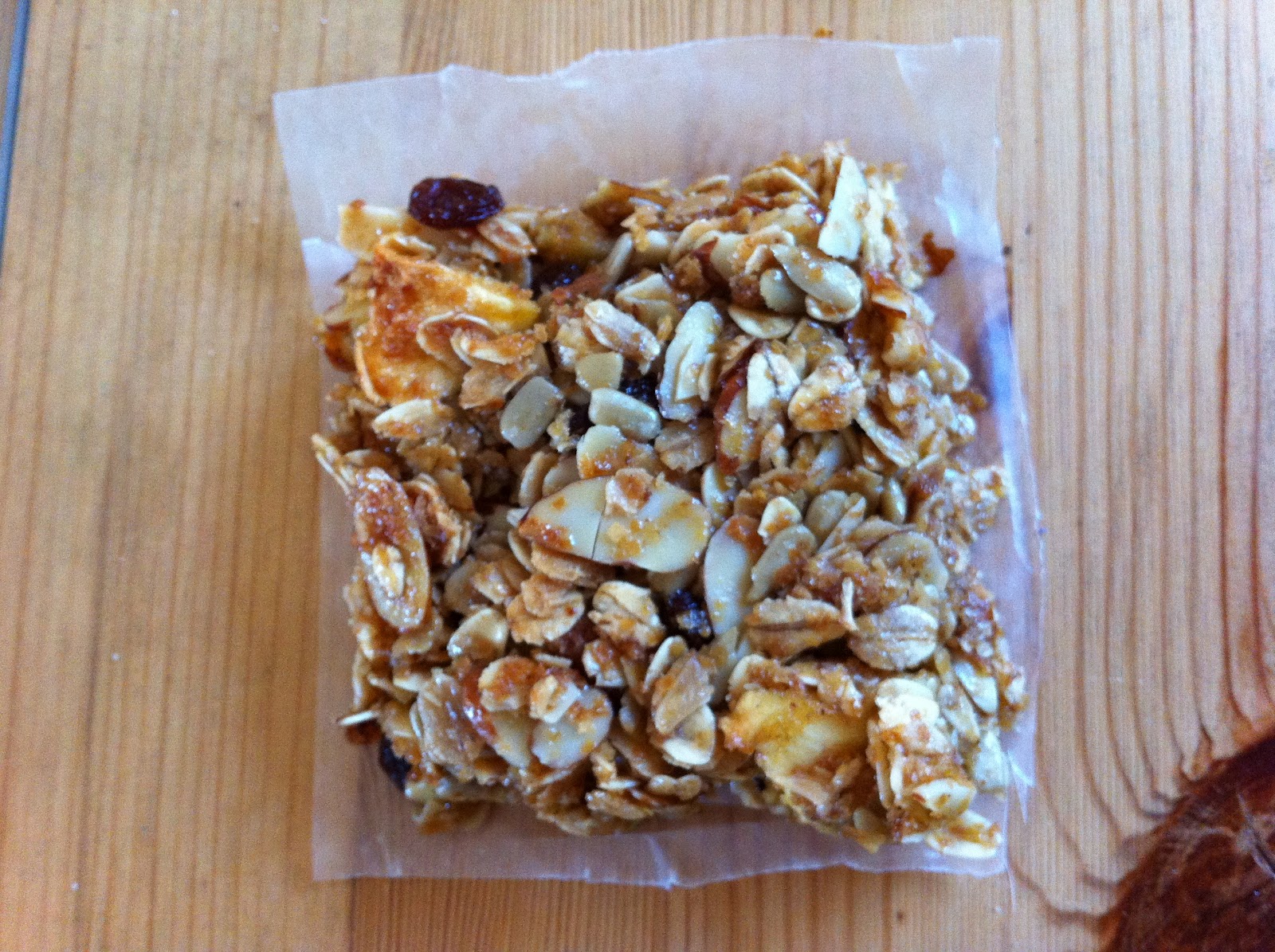
They make a great breakfast treat or quick snack.
Fruit and Nut Pizza
 I tend to have pizza dough on hand. It keeps in the refridgerator for a while, but it tends to ferment--like sourdough. Use what you need and keep the rest for later. Just let it come (mostly) to room temperature before using it.
Pizza Dough
4 1/4 cups Bread Flour, plus extra for kneading
1 teaspoon Salt
2 packages Yeast
2 tablespoons Brown Sugar
1 1/2 cups Warm Water (think bath temperature)
1/4 cup Olive Oil
Filling
1 tablespoon Raisins
1 tablespoon Sunflower Seeds
2 teaspoons Wheat Germ
1 teaspoon Kasha (roasted and cracked buckwheat)
Toppings
Honey
Cinnamon and Sugar
sliced Apple (Granny Smith)
sliced Banana
sliced Almonds
To make the dough: stir the yeast and brown sugar into the water until disolved. Let it foam up (about 10 minutes). Combine the flour and salt in a stand mixer with a dough hook. Start on the lowest speed and pour in the wet ingredients. Mix until it comes together in a ball. Turn out onto a floured counter and knead. Place in a warm, still location and let rise for an hour (or until doubled in volume). Punch down.
(If you've been refridgerating the dough, let the dough warm up and start from here.)
Preheat the oven to 400 degrees.
Tear off a hunk of dough about the size of the palm of your hand. That's good for 1 person. Flour the counter top and spread the dough out from the center until it's rather flat. Sprinkle the fillings into the center and knead. The fillings will fall out and push through. It's ok. Keep kneading and incorporating what falls out. Using a rolling pin, roll the dough out turning and flipping to try and keep a round shape. Transfer to a dusted silicone cutting mat. Dock the dough (poking it all over with a fork) to keep it from poofing up too much.
Sprinkle liberally with cinnamon and sugar. Arange the apple, banana and almonds. Drizzle with a little honey and sprinkle with a little more cinnamon and sugar.
I use a pizza stone, but if don't have one, use a cookie sheet. Transfer the pizza to either the stone or the cookie sheet and bake for 12-15 minutes.
Sunday, October 9, 2011
Preservation
The change of seasons in Colorado. The mornings have turned crisp and the leaves have just started to turn colors. Coworkers everywhere are bringing a surplus of end of year zucchini and tomatoes to leave in the break room for some sucker to take home.
So what to do with the last of the veggies as the growing season comes to a close? Or what do you do if your passion for your garden has flagged and you still have veggies you don't want to get rid of? Or if you want to be completely ready for the coming Apocalypse?
Think preservation, baby.
All the cool kids have been doing it for years. In fact, learning how to grow and preserve your own food is arguably THE transition from nomadic hunter-gatherers to the establishment of civilization. Your grandmother (or great-grandmother, for you young whipper-snappers) likely spent many hours preparing, canning and freezing vegetables to ensure her family had food through the lean winter months.
Preservation encompasses three primary methods: canning, freezing and drying. I love all three and each have their uses, but today we're talking about canning. Many think it's difficult, expensive, and time consuming. No, no and yes. To do it right, that is. But it's worth it for the ability to experiment.
Like cooking, canning encourages a development of flavors that you cannot achieve any other way. Canning demands heat and allows for time--critical elements for the full benefit of taste. Cucumbers transform into dill pickles; strawberry-rhubarb jam blends into something greater than either strawberries or rhubarb. Chutney doesn't become the magic condiment it is until it has rested for a few months inside a jar.
"So," you say, "I want to get started with canning. Where do I begin?" Your local super market or hardware store is ideal. Here's a basic shopping list:
Boiling Water Canner (AKA water bath canner, $5-$80, and cheap is fine here!);
Jar Lifter ($5)
Canning Funnel ($2)
Mason Jars ($12-$20) (Interesting note: Mason Jars were not invented by the fraternal organization, the Masons, but the most prolific producer of Mason Jars is the Ball Company, founded by the Ball brothers. Who were Masons.)
2-part Screw-on Lids ($2-$5)
I also recommend a good starter book like the Ball Blue Book of Preserving. Simple clear instructions and good and delicious recipes.
The beauty of this list? Everything but the lid inserts are reusable. Year after year, and all you need to spend is about $2 for lid inserts. Not bad.
 When canning, think safety. It's not difficult, but it does take time. Make sure everything is clean and sterilized. That means LOTS of hot water. Anything that touches food must be boiled in water for 10 minutes or more, and make certain you keep your hands clean. Wash often. The last thing you want is a case of botulism ruining everyone's dinner. (Another interesting note: the prescription cosmetic Botox® is made from a variant of the botulinum toxin.)
OK. I admit, the possibility of killing everyone who tastes your food adds a little thrill to what would normally be a boring dinner, but that's not why I cherrish canning. I love it because once you have a little practice, you'll find culinary inspiration everywhere. Spices and herbs, fruits and vegetables: all of these can be put into a jar and canned to be taken to new gastronomical heights.
Tonight for dinner:
Carrots Caramelized in Fig and Ginger
2 tablespoons Olive Oil
8 large Carrots, peeled and cut into quarters (in half length-wise, then in half across)
2 cloves Garlic, minced
2 tablespoons fresh Ginger, peeled and minced
1/4 cup Dry White Wine
1 Bay Leaf
Salt and Pepper
3 tablespoons Fig Preserves
Heat the oil in a skillet over medium high heat for 60 seconds. Reduce the heat to medium and add the carrots, garlic and ginger; saute for 3-4 min until the garlic softens and turns aromatic. Add the white wine and bay leaf, cover the pan and simmer for 14-16 minutes.
When the carrots have softened but still firm (you don't want them mushy!), remove the lid and turn up the heat. Most of the wine should evaporate, leaving just a little liquid in the bottom of the skillet. Remove the bay leaf and add the fig preserves. Stir until the preserves dissolve into a syrup, then reduce the heat. Keep stirring until the preserves thicken into a caramel-looking goo and all of the carrots are evenly glazed.
Oven Roasted Tomato Sauce
 This is arguably my "signature" dish. It is certainly my wife's favorite. It takes time, but the results are incredibly worthwhile.
4 tablespoons Olive Oil
Salt and Pepper to taste
1 Onion, chopped
4 cloves Garlic, crushed
1 quart Canned Tomatoes, chopped, liquid included
1/2 teaspoons Crushed Red Chili Flakes (to taste)
2 Anchovies
1 Carrot, peeled and chopped
1 Bell Pepper, seeded and large diced
1/4 cup dry White Wine
1/2 teaspoon Sugar (if needed)
3 tablespoons fresh Oregano, chopped
8-10 Button Mushrooms, sliced (optional)
Heat your oven to 250 degrees. Combine the tomatoes, chili, carrots, garlic, onions, peppers and pour into a cookie sheet with walled sides. Pour slowly or you'll make a heck of a mess. Drizzle olive oil over the top. Spread evenly on the pan and bake for two and half to three hours, stirring and turning over the mixture every 30 minutes. Repeat until the liquid no longer pools in the pan and the tomatos appear intense in color.
In a large saucepan, heat 1 tablespoon olive oil over medium heat and add the anchovies. Stir and mash until the anchovies dissolve. Add the oven roasted tomato sauce. Mix well, and using a stick blender, break the sauce down. Stir in the oregano. Add the mushrooms and keep warm over lowest heat. Serve over fresh pasta with a little cheese.
Spiced Honey
1 cup Honey
2 quarter-inch slices of Lemon
1 stick Cinnamon
2 pods Green Cardamom
6-8 whole Cloves
In a saucepan, heat the all of the ingredients and boil for 2 minutes. Pour all of the ingredients into a sterilized 1/2 pint jar. Seal with a sterile 2 part lid and process in a water bath for 10 minutes. Let the honey season for at least a week or two.
 |
| So many tomatoes |
So what to do with the last of the veggies as the growing season comes to a close? Or what do you do if your passion for your garden has flagged and you still have veggies you don't want to get rid of? Or if you want to be completely ready for the coming Apocalypse?
Think preservation, baby.
All the cool kids have been doing it for years. In fact, learning how to grow and preserve your own food is arguably THE transition from nomadic hunter-gatherers to the establishment of civilization. Your grandmother (or great-grandmother, for you young whipper-snappers) likely spent many hours preparing, canning and freezing vegetables to ensure her family had food through the lean winter months.
Preservation encompasses three primary methods: canning, freezing and drying. I love all three and each have their uses, but today we're talking about canning. Many think it's difficult, expensive, and time consuming. No, no and yes. To do it right, that is. But it's worth it for the ability to experiment.
Like cooking, canning encourages a development of flavors that you cannot achieve any other way. Canning demands heat and allows for time--critical elements for the full benefit of taste. Cucumbers transform into dill pickles; strawberry-rhubarb jam blends into something greater than either strawberries or rhubarb. Chutney doesn't become the magic condiment it is until it has rested for a few months inside a jar.
"So," you say, "I want to get started with canning. Where do I begin?" Your local super market or hardware store is ideal. Here's a basic shopping list:
Boiling Water Canner (AKA water bath canner, $5-$80, and cheap is fine here!);
Jar Lifter ($5)
Canning Funnel ($2)
Mason Jars ($12-$20) (Interesting note: Mason Jars were not invented by the fraternal organization, the Masons, but the most prolific producer of Mason Jars is the Ball Company, founded by the Ball brothers. Who were Masons.)
2-part Screw-on Lids ($2-$5)
I also recommend a good starter book like the Ball Blue Book of Preserving. Simple clear instructions and good and delicious recipes.
The beauty of this list? Everything but the lid inserts are reusable. Year after year, and all you need to spend is about $2 for lid inserts. Not bad.
 When canning, think safety. It's not difficult, but it does take time. Make sure everything is clean and sterilized. That means LOTS of hot water. Anything that touches food must be boiled in water for 10 minutes or more, and make certain you keep your hands clean. Wash often. The last thing you want is a case of botulism ruining everyone's dinner. (Another interesting note: the prescription cosmetic Botox® is made from a variant of the botulinum toxin.)
OK. I admit, the possibility of killing everyone who tastes your food adds a little thrill to what would normally be a boring dinner, but that's not why I cherrish canning. I love it because once you have a little practice, you'll find culinary inspiration everywhere. Spices and herbs, fruits and vegetables: all of these can be put into a jar and canned to be taken to new gastronomical heights.
Tonight for dinner:
Carrots Caramelized in Fig and Ginger
2 tablespoons Olive Oil
8 large Carrots, peeled and cut into quarters (in half length-wise, then in half across)
2 cloves Garlic, minced
2 tablespoons fresh Ginger, peeled and minced
1/4 cup Dry White Wine
1 Bay Leaf
Salt and Pepper
3 tablespoons Fig Preserves
Heat the oil in a skillet over medium high heat for 60 seconds. Reduce the heat to medium and add the carrots, garlic and ginger; saute for 3-4 min until the garlic softens and turns aromatic. Add the white wine and bay leaf, cover the pan and simmer for 14-16 minutes.
When the carrots have softened but still firm (you don't want them mushy!), remove the lid and turn up the heat. Most of the wine should evaporate, leaving just a little liquid in the bottom of the skillet. Remove the bay leaf and add the fig preserves. Stir until the preserves dissolve into a syrup, then reduce the heat. Keep stirring until the preserves thicken into a caramel-looking goo and all of the carrots are evenly glazed.
Oven Roasted Tomato Sauce
 This is arguably my "signature" dish. It is certainly my wife's favorite. It takes time, but the results are incredibly worthwhile.
4 tablespoons Olive Oil
Salt and Pepper to taste
1 Onion, chopped
4 cloves Garlic, crushed
1 quart Canned Tomatoes, chopped, liquid included
1/2 teaspoons Crushed Red Chili Flakes (to taste)
2 Anchovies
1 Carrot, peeled and chopped
1 Bell Pepper, seeded and large diced
1/4 cup dry White Wine
1/2 teaspoon Sugar (if needed)
3 tablespoons fresh Oregano, chopped
8-10 Button Mushrooms, sliced (optional)
Heat your oven to 250 degrees. Combine the tomatoes, chili, carrots, garlic, onions, peppers and pour into a cookie sheet with walled sides. Pour slowly or you'll make a heck of a mess. Drizzle olive oil over the top. Spread evenly on the pan and bake for two and half to three hours, stirring and turning over the mixture every 30 minutes. Repeat until the liquid no longer pools in the pan and the tomatos appear intense in color.
In a large saucepan, heat 1 tablespoon olive oil over medium heat and add the anchovies. Stir and mash until the anchovies dissolve. Add the oven roasted tomato sauce. Mix well, and using a stick blender, break the sauce down. Stir in the oregano. Add the mushrooms and keep warm over lowest heat. Serve over fresh pasta with a little cheese.
Spiced Honey
1 cup Honey
2 quarter-inch slices of Lemon
1 stick Cinnamon
2 pods Green Cardamom
6-8 whole Cloves
In a saucepan, heat the all of the ingredients and boil for 2 minutes. Pour all of the ingredients into a sterilized 1/2 pint jar. Seal with a sterile 2 part lid and process in a water bath for 10 minutes. Let the honey season for at least a week or two.
Sunday, June 12, 2011
Mysteries Around the Corner
We've driven past them. We've wondered about them. And maybe we were afraid to step inside. This is the start of a series of blog posts about the ethnic markets in our (and most likely your) neighborhood and the adventures to be found there.
We picked up dried seaweeds (seasoned laver and something I couldn't understand), dried mushrooms (shitake and black fungus), fresh vegetables (leeks and lotus root), dried noodles (rice, bean and mung), sauces (coconut milk, fermented fish). We explored the frozen foods and found fish balls (go ahead--insert joke here), chicken parts I don't normally associate with food, whole fish and squids and octopuses, shrimp, scallops and other shellfish and many things we couldn't identify. I picked out a large cuttlefish for dinner.
We journeyed down aisle after aisle of canned foods, pastes, broths, jellies, dried noodles and vegetables and preserved fauna and flora of all types. I picked up a tin of Fried Bamboo Caterpillars, which I love toasted in a hot skillet with a dusting of chili powder. We lingered for a long time looking at the marvels of the teas and cookies and candies. What a celebration of flavors!
We asked questions of people who looked like they knew what they were doing, but just the same as if someone in King Soopers asked me, "Do you know what this is?" or "How do you prepare that?" I'd more likely than not be nonplussed.
With all of the exploration, and all the amazing things we brought home, I wasn't sure what to do or what to try. I started off with something I know: technique. As Chef Michael Symon says, "Learn a recipe, you can cook a delicious dish; learn a technique and you can create a meal out of almost anything." My beloved wife and my brother were kind enough to let me experiment on them. Here's the result.
So whenever you feel like you may be in a rut, when you need to try something new or when you seek inspiration, look no further than your own neighborhood and find a world of adventure.
For dinner:
I consider Denver rather cosmopolitan. My lovely wife and I have lived in Santa Fe, Toronto and Denver. We've traveled around the world and we love to explore our own back yard. And I can say with confidence, Denver is cosmopolitan (as well as perfectly homey.) People come to Colorado from all over the nation and from around the world. We have a long history of booms and expansions that required labor--sometimes mental, sometimes back breaking. During the early years of our state, mining and the railroad industry required many workers, and while the pay was often too little for most Americans, the wages still attracted immigrants looking to start a new life in the US. In most metropolitan communities, these same immigrants settled to create their own ethnically unique neighborhoods. It's curious, then, that Denver and its suburbs do not have a Chinatown, even though thousands of Chinese immigrated to Colorado during the late 1800’s and early 1900’s. According to a recent article in the Denver Post, racism played a big part in the destruction of our local Asian community during the 1920's. But thankfully, we still have an extraordinary Asian presence here.
Which is not to say that I've soaked any of it up through osmosis. Yes, I minored in Chinese in college, and I studied Asian literature and religion extensively, but I do not know what the hell I'm doing in the Pacific Ocean Market. Yes, I've been to the Market on many occasions, but really only ever to buy ingredients. I never really explored with the intention of pushing my boundaries and then writing about it.
On entering the supermarket (and it really is super!) it looks very much like a King Soopers or Safeway or other big chain supermarket that you may know and use regularly. There is a bakery, a produce section, aisles arranged in common thematic elements, frozen foods, etc. But getting in close, you'll notice some significant differences. Glazed pork and whole ducks (including heads) hang in cases. The vegetables often don't have English writing on then, but rather Chinese (or Korean, Japanese, Thai or Hindi, as appropriate). When we asked what certain vegetables were, neither staff nor customers seemed to know. (I found out that one of the items was Bitter Melon, and as the name implies, was absolutely horrible. More later.) But for the day, we found more gems than things we loathed.
As discussed in numerous previous blog entries, I seek out culinary adventure. So I intended to try things that I had never tried before. I confess, I chickened out in a couple of instances, but I pushed myself as much as I reasonably could. And not knowing what I was doing, I made the most of my experiences.
 |
| A Sample of the Haul: seaweeds, dried mushrooms, candies, unusual beverages, vegetables and a cuttlefish |
We journeyed down aisle after aisle of canned foods, pastes, broths, jellies, dried noodles and vegetables and preserved fauna and flora of all types. I picked up a tin of Fried Bamboo Caterpillars, which I love toasted in a hot skillet with a dusting of chili powder. We lingered for a long time looking at the marvels of the teas and cookies and candies. What a celebration of flavors!
We asked questions of people who looked like they knew what they were doing, but just the same as if someone in King Soopers asked me, "Do you know what this is?" or "How do you prepare that?" I'd more likely than not be nonplussed.
With all of the exploration, and all the amazing things we brought home, I wasn't sure what to do or what to try. I started off with something I know: technique. As Chef Michael Symon says, "Learn a recipe, you can cook a delicious dish; learn a technique and you can create a meal out of almost anything." My beloved wife and my brother were kind enough to let me experiment on them. Here's the result.
 |
| The finished meal. Mung Bean Noodles, Seaweed Salad, Poached Cuttlefish, Stir Fried Lotus Root and a tasty beverage |
For dinner:
Cuttlefish Poached in Coconut Milk and Lemongrass
I first had cuttlefish, stuffed and grilled in Little Portugal in Toronto. The flesh is meaty, fleshy, mild, yet flavorful. I didn't have the opportunity to stuff or grill it, so I took a different approach.
20oz Cuttlefish, cleaned and prepared (innards, beak and cuttle bone removed; talk to your fishmonger, if you'd like)
1/4 cup Olive Oil
1/2 teaspoon Salt
16oz can Coconut Milk
3 stalks Lemongrass
Sprinkle the cuttlefish on all sides with the salt and slide into a large plastic bag. Add the olive oil and squish it around until the cuttlefish is completely covered. Let stand for 45 min to an hour.
Trim the lemongrass. Using a heavy, sharp knife, remove the root-end, up about a 1/4 inch. Cut about 4 inches up from the root side of the stalk, or about where the flesh goes from firm to loose leaves. Then split that shorter stalk length-wise.
Get a skillet large enough to hold the whole cuttlefish and get it hot on the highest heat your stove has. Slide the cuttlefish (and its attendant oil) into the skillet and sear the cuttlefish for 2-3 minutes. Using long tongs, flip the cuttlefish and sear the other side.
Reduce the heat to low and immediately add the lemongrass. Add the coconut milk. Cover and let simmer for 45 minutes. Really, now is the time for low and slow. If you cook it too hot, you will be chewing on rubber.
Slice and serve.
Reduce the heat to low and immediately add the lemongrass. Add the coconut milk. Cover and let simmer for 45 minutes. Really, now is the time for low and slow. If you cook it too hot, you will be chewing on rubber.
Slice and serve.
Seaweed Salad
Turning dried seaweed into salad is far more palatable than it may sound. And pretty darn easy, too.
1/2 cup Dried Seaweed, chopped into 1/2 inch lengths (I know there are many different kinds of seaweed, but for the life of me I cannot discover what type or species this one is. It simply says "Contents: Dried Seaweed." The Inuit reportedly have a whole slew of words for snow, and I have to believe that the Japanese would have more than one word to describe seaweed, but the translators of the packaging will only offer us the one word I already know. "Seaweed.") (And this is a good example of me having some good-natured ribbing. Did you even click through the last link and read the article? Well, go ahead. I'll still be here when you get back.)
4-6 cups cold Water
3-4 tablespoons Sesame Oil (I used chili-infused sesame oil for a bit of kick)
3 tablespoons Rice Wine Vinegar
1/2 teaspoon sugar
Salt and pepper to taste
2 Scallions, sliced thin
Sprinkle of toasted Sesame Seeds
Immerse the dried seaweed in the cold water until it completely hydrates (about 30 minutes). In the meantime, combine the oil, vinegar and sugar in a blender. Blend for 20-30 seconds. Taste it and add salt, pepper, more vinegar or sugar, as needed. Blend again, to combine, right before using the dressing.
Drain the seaweed thoroughly. Toss with the dressing and serve. Garnish with scallions and sesame seeds.
Stir Fried Lotus Root with Black Fungus
1 Lotus Root, Whole
A large bowl of cold water (2-3 quarts) with 2 tablespoons vinegar mixed in
1 Lotus Root, Whole
A large bowl of cold water (2-3 quarts) with 2 tablespoons vinegar mixed in
1 cup Dried Black Fungus (or other mushroom)
A similarly large bowl of near-boiling water (or a pot--you want to have a cover for it)
1 Leek, trimmed, cleaned and sliced into very thin rings
1 clove Garlic, minced
2 tablespoons vegetable oil
A drizzle of Soy Sauce
1 teaspoon Red Pepper Flakes (more or less to taste)
Using a sharp knife, remove the outer skin of the lotus root. Slice the root into 1/4-3/8 inch slices. Try to keep the rounds intact, as the visual elegance is part of the appeal. Put the slices into the vinegar water. (This helps to keep the lotus root from discoloring and removes some of the alkali taste.) Add the dried fungus to the hot water and cover. Wait on both of these for 30-45 minutes.
When the fungus has completely rehydrated, drain it and chop into bite-sized pieces. Drain the lotus root. On high heat, get your wok (or large frying pan) very hot. (A drop of water should sizzle and evaporate almost instantly.) Add the vegetable oil to the wok and wait 30-45 seconds. The oil should start to smoke. Carefully add the lotus root (the oil WILL pop so be very careful!) and saute for 2 minutes. Add the fungus. Saute for 1 minute. Add the leek, garlic, pepper flakes and toss to combine. Add a little soy sauce for flavor, toss to combine and serve.
Dark Rum and Young Coconut Drink
We found a number of interesting beverages at the Pacific Ocean Market. Honey and Basil Seed Drink, Aloe Juice, Lemon Soda (with a marble in the bottle) and Young Coconut Drink. Young coconut Drink is very sweet and has shavings of coconut suspended in it. It goes great with a fine dark rum. In this case we mixed rum to Young Coconut Drink in a 2:3 ratio and served over ice in a rocks glass.
For more photos, please visit my Facebook page.
Sunday, March 13, 2011
Oops and Opportunities
When caught in an absolute whirlwind of life, I tend to unwind in the kitchen. And boy have I been creative in the kitchen this past month! Here are a handful of things I've been working on:
Lavender Bitters
Winter Vegetable Bake
Greek Stir-Fry
Chicken Soup Pot Pie
Crepes
. . . and few dishes that were just OK to flat out bad. (My darling bride and kitchen-mate was thoroughly unimpressed by Tilapia and Shrimp in an Orange Cream Sauce.)
Ask me how I recover from a bad recipe experiment.
Well, after some minor embarrassment and scraping of dishes into the compost, I think back to where I went south. More often than not, it was the wrong amount of one ingredient, the improper cooking temperature or a bad guess on cooking time (the last two can generally be summed up as "awful texture.") If the principles of the dish are sound and I can identify the problem, I will try it again with tweaks. On the other hand, if my panel of expert taste-tester (see "darling-bride and kitchen-mate" reference, above) suggests that I should abandon the dish altogether, I drop it like the proverbial rotten potato it might be. I have thereby successfully avoided repeats of the Sesame Fried Tofu incident, the Scallops Encrusted in Tapioca Flour, or the dreaded Fried Squash Blossoms with Fish-Paste Filling. (DON'T JUDGE ME!)
Now and then, however, one of those mistakes becomes serendipity. Overcooking can lead to caramelization which can be delicious when everything else works out. Too much of one spice can create a new emphasis on the palate. And cooking something too long and at too low of a temperature can concentrate flavors and make everything a little more bold. Here's a couple of near mistakes we've decided are worth keeping.
Greek Stir-Fry
We emptied a family member's refrigerator of all the perishables that might perish before they return from vacation. We combined the ingredients with a few things I had in our kitchen and then I cooked it way too quickly on too high of a temperature. With a little doctoring, here is the happy result.
2 tablespoons Canola Oil
6-8 large stalks of Kale, de-stemmed and chopped (I used 5 stalks of Bok Choy (with stems) instead)
8 large Mushrooms, sliced
1/4 of a medium Onion, chopped
1 teaspoon of dried Oregano
1/2 cup Greek Yogurt
juice of 1/2 Lemon
1 brick of Firm Tofu, drained and cut into 1 inch cubes
1/4 cup crumbled Feta Cheese
Heat a wok or deep skillet on high heat for 90 seconds. It may start to smell like a hot skillet. That's good. Add the canola oil and wait for 30 seconds. Swirl it around and add the kale, mushrooms and onion. Let rest for 10 seconds, then flip it around with a spatula. Saute for 2 minutes on very high heat, then add the oregano, yogurt, and lemon juice. Get it hot again. Add the tofu, stir and remove it from the heat. Sprinkle with Feta cheese and serve over couscous. Or rice. Or left over polenta like I did.
Lavender Bitters
This started off as Cucumber Bitters, but that didn't work out AT ALL! But it did make really great lavender bitters.
750 ml Everclear
1 12 inch English Cucumber sliced
8 oz dried Lavender blossoms
6 oz dried and crushed Orange Peel
40 drops Gentian Root Extract
Combine all the ingredients in a clean jar. Shake every 2 days. Filter thorougly and rebottle. Use sparingly whenever an herbal punch is needed.
Lavender Bitters
Winter Vegetable Bake
Greek Stir-Fry
Chicken Soup Pot Pie
Crepes
. . . and few dishes that were just OK to flat out bad. (My darling bride and kitchen-mate was thoroughly unimpressed by Tilapia and Shrimp in an Orange Cream Sauce.)
Ask me how I recover from a bad recipe experiment.
Well, after some minor embarrassment and scraping of dishes into the compost, I think back to where I went south. More often than not, it was the wrong amount of one ingredient, the improper cooking temperature or a bad guess on cooking time (the last two can generally be summed up as "awful texture.") If the principles of the dish are sound and I can identify the problem, I will try it again with tweaks. On the other hand, if my panel of expert taste-tester (see "darling-bride and kitchen-mate" reference, above) suggests that I should abandon the dish altogether, I drop it like the proverbial rotten potato it might be. I have thereby successfully avoided repeats of the Sesame Fried Tofu incident, the Scallops Encrusted in Tapioca Flour, or the dreaded Fried Squash Blossoms with Fish-Paste Filling. (DON'T JUDGE ME!)
Now and then, however, one of those mistakes becomes serendipity. Overcooking can lead to caramelization which can be delicious when everything else works out. Too much of one spice can create a new emphasis on the palate. And cooking something too long and at too low of a temperature can concentrate flavors and make everything a little more bold. Here's a couple of near mistakes we've decided are worth keeping.
Greek Stir-Fry
We emptied a family member's refrigerator of all the perishables that might perish before they return from vacation. We combined the ingredients with a few things I had in our kitchen and then I cooked it way too quickly on too high of a temperature. With a little doctoring, here is the happy result.
2 tablespoons Canola Oil
6-8 large stalks of Kale, de-stemmed and chopped (I used 5 stalks of Bok Choy (with stems) instead)
8 large Mushrooms, sliced
1/4 of a medium Onion, chopped
1 teaspoon of dried Oregano
1/2 cup Greek Yogurt
juice of 1/2 Lemon
1 brick of Firm Tofu, drained and cut into 1 inch cubes
1/4 cup crumbled Feta Cheese
Heat a wok or deep skillet on high heat for 90 seconds. It may start to smell like a hot skillet. That's good. Add the canola oil and wait for 30 seconds. Swirl it around and add the kale, mushrooms and onion. Let rest for 10 seconds, then flip it around with a spatula. Saute for 2 minutes on very high heat, then add the oregano, yogurt, and lemon juice. Get it hot again. Add the tofu, stir and remove it from the heat. Sprinkle with Feta cheese and serve over couscous. Or rice. Or left over polenta like I did.
Lavender Bitters
This started off as Cucumber Bitters, but that didn't work out AT ALL! But it did make really great lavender bitters.
750 ml Everclear
1 12 inch English Cucumber sliced
8 oz dried Lavender blossoms
6 oz dried and crushed Orange Peel
40 drops Gentian Root Extract
Combine all the ingredients in a clean jar. Shake every 2 days. Filter thorougly and rebottle. Use sparingly whenever an herbal punch is needed.
Monday, April 19, 2010
Dinner Tonight
Asparagus in a Cream Sauce over Pasta
Olive Oil
1 Leek, greens discarded, diced
1 clove Garlic, minced
1 cup chopped Asparagus
10 medium Button Mushrooms, chopped
3/4 teaspoon Salt
1/2 teaspoon Pepper
3/4 cup Skim Milk
3/4 cup Heavy Cream
1/2 cup Walnuts, chopped
Cooked Pasta (your choice)
Sautee the leak and garlic over medium heat with a pinch of salt until soft and they start to turn translucent. Add the asparagus, mushrooms and walnuts. Continue to stir until the asparagus STARTS to get tender. Add more salt and pepper, to tase.
Reduce the heat to medium low. Poor in the milk and cream. Stirring occasionally, let simmer until the milk is reduced to the consistency you like.
Spoon over warm pasta and sprinkle with a grated dry, hard cheese.
Sunday, April 11, 2010
New Horizons and Common Grounds
"The role of the artist is exactly the same as the role of the lover: If I love you I have to make you aware of things you wouldn't ordinarily see." --James Baldwin
There are so many things that make me happy that one could confuse me with a pure simpleton, but in all honesty, the littlest things DO bring me joy. Biting the ears off a chocolate bunny, sipping good whiskey, smoking a good cigar and laughing with good friends. Those are the kind of things that bring joy to life. And then there is the adventure of expanding horizons.
Today was a perfect day. Before I dashed off, I tended to the budding Victory Garden on the dining room table, worked in the morning (nothing new for a Saturday and I love my clients), then my Beloved and I went to the Butterfly Pavilion to watch a cooking demonstration. Sushi for lunch then home for a cigar and bourbon (whiskey--see above) on the back deck.
Today was slightly unusual in a couple of respects, however.
First, there is the concept of the Victory Garden. From its noble beginnings, today it often implies self-sufficiency and frugality. Indeed, those are my specific intentions. I know everything is organic and a measure of pride from the work of my own hands. I love to save money on the vegetables I won't be buying. I love the depth of flavors of home-grown vegetables. And seeing life spawn under the earth and wriggle into existence presents itself as a metaphor of rebirth. "He who has seeds, has Spring." (Ben Franklin) In the last blog entry, I made mention that we want to eat better. What could be better for the body and soul than to have produced your own produce?
But the second important difference of the day, we engaged in entomophagy. Quite literally, the eating of bugs. David George Gordon, "The Martha Stewart of the Bug World" or in his words, "The Emeril of Entomophagy" (I think he made that one up while we were there) presented a wonderfully charming tour of food and creepy-crawlies. He begins by inviting kids to join him up front and sit on the floor. (He and I agree on the nature of children: children harbor more germs than the bugs we're tasting today. If you can keep them sitting and not hovering, breathing into the mis-en-place, we'll have an enjoyable afternoon. And he handled the squirrelly kids better than their parents did!) He then outlined the role of bugs in food--the bugs we don't think we're eating (think peanut butter), the bugs that we don't know about which are supposed to be there (think natural ingredient, red food coloring), and the bugs that various cultures around world consume for their nutritional value.


Salt & Pepper
1/4 teaspoon freshly ground Nutmeg
1/2 cup Heavy Cream
Boil the leaves for 2 minutes, then strain, pressing out any extra water. Chop thoroughly and set aside.
Melt the butter in a sauce pan (medium high heat) and saute the leak and garlic until they are tender and starting to turn translucent. Add the greens and cook, stirring regularly until they start to give off moisture. Add the seasonings and cream and continue to cook, stirring occasionally until the cream is reduced and thickened to how you like it.
Serve hot with as a side for almost any Southern comfort food!
There are so many things that make me happy that one could confuse me with a pure simpleton, but in all honesty, the littlest things DO bring me joy. Biting the ears off a chocolate bunny, sipping good whiskey, smoking a good cigar and laughing with good friends. Those are the kind of things that bring joy to life. And then there is the adventure of expanding horizons.
Today was a perfect day. Before I dashed off, I tended to the budding Victory Garden on the dining room table, worked in the morning (nothing new for a Saturday and I love my clients), then my Beloved and I went to the Butterfly Pavilion to watch a cooking demonstration. Sushi for lunch then home for a cigar and bourbon (whiskey--see above) on the back deck.
Today was slightly unusual in a couple of respects, however.
First, there is the concept of the Victory Garden. From its noble beginnings, today it often implies self-sufficiency and frugality. Indeed, those are my specific intentions. I know everything is organic and a measure of pride from the work of my own hands. I love to save money on the vegetables I won't be buying. I love the depth of flavors of home-grown vegetables. And seeing life spawn under the earth and wriggle into existence presents itself as a metaphor of rebirth. "He who has seeds, has Spring." (Ben Franklin) In the last blog entry, I made mention that we want to eat better. What could be better for the body and soul than to have produced your own produce?
But the second important difference of the day, we engaged in entomophagy. Quite literally, the eating of bugs. David George Gordon, "The Martha Stewart of the Bug World" or in his words, "The Emeril of Entomophagy" (I think he made that one up while we were there) presented a wonderfully charming tour of food and creepy-crawlies. He begins by inviting kids to join him up front and sit on the floor. (He and I agree on the nature of children: children harbor more germs than the bugs we're tasting today. If you can keep them sitting and not hovering, breathing into the mis-en-place, we'll have an enjoyable afternoon. And he handled the squirrelly kids better than their parents did!) He then outlined the role of bugs in food--the bugs we don't think we're eating (think peanut butter), the bugs that we don't know about which are supposed to be there (think natural ingredient, red food coloring), and the bugs that various cultures around world consume for their nutritional value.
Then the fun began. Asking for volunteers to cook the food, and other volunteers to taste the food, "we" cooked and ate Tempura Mealworms, Panfried Scorpion, Orthopteran Orzo, and Grasshoppers on a skewer. My wife was the only volunteer to eat all of her Mealworm (I am so proud of her!) and the Scorpion I had tasted like soft-shell crab. In fact, I can't wait to go scorpion hunting when I have the chance. I can envision it in a nori roll (think Spider Roll, literally) or with rice and beans served Southwestern style.


Ok--so entemophagy is a little extreme and I doubt it will become a regular part of our diet, but I don't think we're going to shy away, either.
Adventure has been a regular staple of my spiritual diet for as long as I can remember. Culinarily speaking, I include it in increasingly regular intervals. I'll let you know how it goes.
Tonight we're eating vegetarian, with a twist.
Creamed Dock (or Cream of Wild Greens)
Sourdock is a wild leafy vegetable (aka, weed) that grows plentifully in open fields across North America. The leaves are best in spring when they are young and tender. Caution: as with all wild plants, good identification and good growing conditions are essential. Many plants have natural or pesticide/herbicide toxins that can be harmful (or worse!) if swallowed. When in doubt, avoid it.
2 pound young fresh Dock leaves, rinsed, blanched twice and thick stems removed
2 tablespoons Butter
1 Leak, tender white part chopped and greens reserved for something else
1 clove Garlic, mincedSalt & Pepper
1/4 teaspoon freshly ground Nutmeg
1/2 cup Heavy Cream
Boil the leaves for 2 minutes, then strain, pressing out any extra water. Chop thoroughly and set aside.
Melt the butter in a sauce pan (medium high heat) and saute the leak and garlic until they are tender and starting to turn translucent. Add the greens and cook, stirring regularly until they start to give off moisture. Add the seasonings and cream and continue to cook, stirring occasionally until the cream is reduced and thickened to how you like it.
Serve hot with as a side for almost any Southern comfort food!
Friday, April 2, 2010
The Gauntlet Has Been Thrown
Ok. I recognize you deserve better. I'm embarassed. There is shame in our household, and I am the reason.
The last blog, while answering important questions I've been asked, got . . . well . . . boring.
But in every challenge comes opportunity. I have been dared--no, DOUBLE DOG DARED--to go vegetarian.
Not entirely vegetarian. We'll eat eggs and dairy, and red meat, chicken and fish each once a week.
We recognize that we don't eat as well as we might. Please understand that we don't eat as poorly as many, but we hold ourselves to a very high standard. ( We throw away less than 1 cubic foot of trash per week. We compost everything compostable. And most vegetable peelings and scraps get boiled down to a broth before they get composted.) We tend to eat venison or elk when the previous hunting season was successful. But we don't do veggies the way we should. Can I cook meatless dishes with the same enthusiastic creativity?
I'd like to think so.
So here's the rules: Sunday, Wednesday and Friday (can be changed with Saturday) are meat nights. Every other night, a meat product can be used as seasoning, but not the featured course.
Further updates as events warrant.
A veggie dinner. And a side dish.
Mediterranean Eggplant Casserole
1 Eggplant
2 tablespoons Olive Oil
2 cloves of Garlic, pressed
1 Onion, chopped
5 Anchovies
1 28 oz can Crushed Tomatoes
1 cup sliced Mushrooms
dried Basil and Oregano, to taste
2 tablespoons of Olive Oil
8-10 large leaves of Kale or Swiss Chard
Kosher Salt
Ground Black Pepper
Peel the eggplant and slice into 1/2 inch rounds. Sprinkle both sides lightly with salt and place on a cooling rack over a paper towel. Let stand for 20-30 minutes. (This takes a lot of the bitterness out of the eggplant.)
In a heavy skillet, heat the olive oil to medium hot (the oil should move like water over the bottom of the pan). Add the pressed garlic and the anchovies and with a fork, crush and stir into a paste. Add the tomatoes, mushrooms and herbs. Stir to combine and reduce the heat to a simmer.
Preheat oven to 350 degrees.
Cut the center stalk out of center of the leaves and chop into 2-3 inch pieces. In another skillet, heat the other 2 tablespoons of olive oil to very hot. (The oil moves faster than water and is just strating to smoke.) Put into the hot oil with a sprinkle of salt. Toss quickly with tongs until evenly wilted. Remove from the pan to paper towels on a plate.
When the sauce is slightly reduced, and the eggplant has released some of its moisture, begin assembly. Spray a 9x13 casserole dish with some kind of antistick spray. Lay down 1/2 of the sauce and then a layer of the kale. Place the eggplant slices evenly over the sauce, sprinkle lightly with black pepper, then add the remaining kale, and top with the remaining sauce. Dust with a hefty layer of grated parmesan cheese. Bake for 20 minutes or until the cheese is a deep golden grown and the sauce is bubbling.
Let stand for 10 minutes and serve with a nice white wine. Try Yard Dog.
Sauted Brussel Sprouts with Roasted Fennel and Gorganzola
a dozen or so firm Brussel Sprouts
1 bulb of Fennel Root
Olive Oil
Salt and Pepper
Bacon Fat
1/4 cup of the stinkiest Gorgonzola Cheese, crumbled
Slice the end root stub and the leaves and woody stalks off the fennel. Slice it lengthwise into 6 wedges. Place into oven-proof skillet, drizzle with olive oil and sprinkle with salt. Roast at 400 degrees for 17 minutes. Remove from the oven and let cool.
Slice the ends off the sprouts then slice them vertically (tip to stem). Melt a tablespoon of bacon fat in a heavy skillet. Add the sliced sprouts, add salt and pepper, reduce heat to medium high and saute until the interior leaves are nicely browned. Chop the roasted fennel and add to the saute. When everything is hot, remove from heat, put into serving dish and sprinkle with the cheese.
Bon Appetit!
Saturday, January 16, 2010
Amazing Things You'll Find on the Internet
Sometimes, serendipity happens. I love finding things that I didn't know existed. Like the blobfish. I never knew that existed. And forgive me for being so species-centric, but man! is it ugly!
But this is a food blog, and I cannot imagine eating one of these things.

Foodies have their fun on the net as well. Take The Grill Sergeants! This website showcases The Pentagon Channel's on-air cooking show. Make no mistake, the recipes are ok and typically taste good enough (albeit the printed format is often incomplete), and is perfectly representative of nearly every other cooking show. The real magic lives in the personalities. Each chef is, as the name suggests, a Sergeant in the military. For example, SFC Brad Turner, combines the on-air personality of Emeril Lagasse with the in-your-face charm of R. Lee Ermey. And if it sounds like terrifying spectacle, well, it is.
While cooking and food sites usually boil down (forgive the pun?) to a list of recipes (if you're lucky) and lots of advertising for kitchen gadgets, a few exceptions stand out. Cook's Illustrated gathers all of it's revenue from subscriptions and production of PBS shows and has no advertising on its website nor in its magazine. Its product reviews are objective, with the end user in mind, and the recipes (complete with an almost Carl Sagan-like nerdiness of explaination behind them) are nearly foolproof and quickly sorted with their search engine. However, as their intellectual property is their only revenue, you must pay to play. (Worth every penny IMHO.)
I also rather enjoy Cooking.com, but the recipes all have some kind of agenda. For example, look for "rice." 739 results and not one tells you how to cook rice. Sure you can see how to make a serviceable paella, but if someone wants to make a pot of rice . . . tough.
And then there is the discussion of vegitarian vs. carnivores. Or worse, vegitarian vs. vegan. Regardless of your politcal stance, basic nutrition dictates that a balanced diet has room for some meat and far more veggies than most of us eat. The World Wide Web is another story, though! Meat is comparatively under-represented. There are some gems, though. Case in point, the very classy, very well designed Exotic Meats USA. Lovely to look at, easy to navigate, simple to shop. Also, entertaining to read. (Look for the "Eat Your Mascot, 8Lbs. Sampler.") However, the recipes are a challenge to find, and not numerous.
Compare this to VegCooking, a very good source for vegetarian and vegan recipes and musings. But not as pretty to look at. (As an aside, will someone please tell me, why do vegetarians WANT everything to to be meat? "Mock Fish." "Mama Gleaton's Tofu Turkey with Dressing." " 'Beef' and Broccoli Stir-Fry." Meat substitutes can be found everywhere and in all forms. Rare is the product or recipe that touts, "I am not a meat and proud of it.")
But the most disturbing vegan cuisine, at least visually, is Cuitlacoche, a corn fungus. I will say little more on the subject. However, Steve says a LOT more, and far more colorfully than I would dare on this family-oriented posting.
The culinary arts are warming up and I'm excited to discover where the future will take us. Wherever it may be, I know I'll be able to get there on the often frustrating, occasionally informative and always amazing internet.
And in case you thought I would leave you stranded:
Rice
Put between 1/3 and 1/2 cup of dry white rice per person into a pot. Tap the side of the pot until the rice is evenly distributed over the bottom of the pan. Barely touch your fingertip to the top of the rice and fill with cold water until the water comes 1/2 way between the 1st and second knuckle. Add a bit of salt. Put it on the stove on high and bring to a boil. Without lifting the lid, immediately reduce the heat to low and simmer for 20 minutes. (If you use an electric burner instead of gas, put it on another burner or you will boil it too long while the element cools down.) Let stand, covered, for a minute or two while you set the table, fluff the rice and serve.
Wednesday, January 13, 2010
A Quick Non-Salad Salad
Fist-Full-of-Salad
I got home from work and didn't feel like cooking. Fortunately, we had a lot of leftovers. Unfortunately, everything was protein and starch--no nutritious vegetables. But what to do that's fresh and not labor intensive? This one took 5 minutes.
4 large Butter Lettuce leaves, washed
1 large grated Carrot
1 medium Tomato, chopped
fistful of dried Cherries/Raisins/Crasins/other fruit
1 Clementine, peeled & sectioned
Salt & Pepper to taste
a drizzle of your favorite Salad Dressing (I just use Olive Oil and a splash of Red Wine Vinegar)
fistful of Grape Nuts/Nuts/other crunchy stuff
Layer the goodness on top off of each leaf. Sprinkle with salt, pepper. Top with a little less salad dressing than what you think you need (you can always add more).
Eat it like a taco.
Try adding shrimp, chopped hard boiled egg or cheese for protein.
Subscribe to:
Posts (Atom)

 Posts


